Cassandra Feuerstein Net Worth sits at roughly $1.15 million in 2026, and almost none of it came from a job she chose.
It started with a routine DUI arrest in March 2013, one that turned into a case of documented police misconduct inside a Skokie, Illinois police station. What followed was a federal lawsuit, an $875,000 settlement, and a financial story that looks nothing like a typical celebrity profile.
This isn’t a story about business deals or career growth. Understanding Cassandra Feuerstein Net Worth means understanding what happened to her, how the settlement was structured, and why her income has stayed modest ever since. Here’s the full, fact checked breakdown.
Quick Facts Table
Here’s a fast snapshot of who Cassandra Feuerstein is and where her net worth stands in 2026.
| Category | Details |
| Real Name | Cassandra Feuerstein |
| Net Worth (2026) | Approximately $1.15 Million |
| Primary Income Source | $875,000 civil rights settlement |
| Secondary Income | Advocacy work, public speaking, consulting |
| Nationality | American |
| Age | Late 50s (born c. 1965–1966) |
| Profession | Civil rights advocate, public speaker |
| Marital Status | Married (as of the 2013 incident) |
| Children | Two daughters (teenagers at the time of the incident) |
| Location | Chicago metro area, Illinois (West Rogers Park) |
| Legal Representation | Torreya Hamilton, co-counsel Lawrence Jackowiak |
| Known For | 2013 Skokie police misconduct case |
| Last Updated | 2026 |
You’ll notice this table answers the two questions people usually search first: how much she’s worth, and how she got there. Everything below breaks that number down piece by piece.
Who Is Cassandra Feuerstein? (Background)
Cassandra Feuerstein wasn’t a public figure by choice. Before March 2013, she was living a quiet, private life in the Chicago area, and nothing about her routine suggested she’d one day become a recognized name in civil rights advocacy.
Public records place her birth around 1965 or 1966, though she’s never confirmed an exact date. She’s kept most personal details out of the spotlight, including information about her parents, siblings, and education.
What changed wasn’t her personality or ambition. It was a single incident that pulled her into a national conversation about police accountability, one she never asked to be part of.
Before 2013
Cassandra Feuerstein lived in West Rogers Park, a residential neighborhood in Chicago, with her husband and two teenage daughters. She held a regular job and had no criminal record, no media presence, and no public profile of any kind.
There’s no indication she pursued fame, business ventures, or public advocacy work during this period. Her life before 2013 looked like that of any private citizen: stable, low profile, and entirely disconnected from the case that would later define her public identity.
That ordinary background matters. It’s part of why her story resonated so widely once it became public. She wasn’t a celebrity looking for a platform. She was a private individual whose life changed because of what happened to her, not because of anything she set out to build.
Cassandra Feuerstein Net Worth 2026
Cassandra Feuerstein’s net worth is estimated at $1.15 million in 2026.
That figure doesn’t come from a business, a salary, or investment gains. It comes almost entirely from one event: the $875,000 civil rights settlement she received in 2015, combined with modest, irregular income she’s earned since through advocacy work and public speaking.
Here’s how the pieces fit together. The settlement forms the base of her net worth, and her ongoing income adds a smaller layer on top each year.
She earns an estimated $70,000 annually from speaking engagements, consulting, and occasional media appearances, though that number changes depending on how many opportunities come up in a given year.
Unlike most people you’ll find on a typical net worth list, Feuerstein doesn’t run a company, hold a salaried position, or draw income from a personal brand.
Her financial profile is unusually simple: a legal settlement, and a modest, story driven income stream that’s kept her financially stable since.
Net Worth Snapshot (2026)
| Category | Amount / Detail |
| Estimated Net Worth | $1.15 Million |
| Primary Source | $875,000 civil rights settlement (2015) |
| Secondary Source | Advocacy, speaking, and consulting income |
| Estimated Annual Income | $70,000 |
| Estimated Monthly Income | $5,800 (varies by year) |
| Business Ventures | None publicly reported |
| Investment Portfolio | Not publicly disclosed |
| Financial Status | Stable, middle class |
If you’re wondering why her net worth is measured in the low millions rather than tens of millions, it comes down to one fact: this wasn’t built through a career.
It was built through compensation for a documented injury, and everything since has stayed proportionate to that starting point.
VISUAL: Infographic-style Net Worth Breakdown
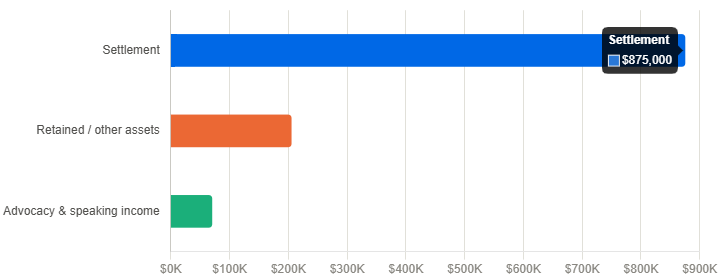
This visual breaks down exactly how the $1.15 million comes together, the settlement, other retained assets, and yearly advocacy income, so readers (and AI summarizers) can see the composition at a glance instead of digging through paragraphs.
The 2013 Skokie Incident, Full Timeline
Cassandra Feuerstein’s story starts with a routine DUI arrest that turned into a documented case of police misconduct. Here’s exactly how it unfolded, from the arrest itself to the courtroom outcome years later.
Timeline of Events
| Date | Event |
| March 10, 2013 (approximately 6:00 AM) | Skokie police find Feuerstein asleep behind the wheel near Howard Street and East Prairie Road. She’s arrested on suspicion of DUI. |
| March 10, 2013 | During booking at the Skokie Police Station, Officer Michael Hart shoves her face first into a concrete bench after she doesn’t look at the camera for her mugshot. |
| March 10, 2013 | She suffers a shattered facial bone, loose teeth, and nerve damage. She later undergoes reconstructive surgery and receives a titanium plate. |
| March 2013 | Hart initially reports that Feuerstein resisted arrest, adding a false charge against her. |
| October 9, 2013 | Surveillance footage of the incident became public, drawing national attention. |
| October 9, 2013 | Feuerstein files a federal civil rights lawsuit against Hart, the Village of Skokie, Sgt. Michael Healy, and Officer Mary Escobedo. |
| November 2013 | Hart resigns from the Skokie Police Department as termination proceedings begin. |
| Early 2014 | Hart is criminally charged with felony aggravated battery and official misconduct. |
| November 12, 2014 | Hart pleads guilty to official misconduct before Judge Matthew Coghlan. He’s sentenced to two years of probation. |
What the Video Showed
The surveillance footage is what turned this from a routine DUI case into a national story. It captured the exact moment Officer Hart pushed Feuerstein toward the booking area, and showed her face making direct contact with a concrete bench with enough force to fracture bone.
Before the footage came out, Hart’s report claimed she’d resisted arrest. Once the video surfaced, that account didn’t hold up. There was no struggle visible, no resistance to justify the level of force used.
It’s the kind of evidence that leaves little room for interpretation, and it’s a big part of why the case moved toward a settlement rather than a drawn out legal fight.
The footage also became public record and was picked up by local news outlets, which is what first brought Feuerstein’s name into the public conversation. Without that video, this case likely stays a private matter between her and the department. With it, accountability became unavoidable.
The $875,000 Settlement, Full Breakdown
Cassandra Feuerstein’s $875,000 settlement wasn’t a single payout. It came together through two separate agreements, filed weeks apart, that together resolved her federal civil rights lawsuit.
Her legal team, led by attorney Torreya Hamilton with co-counsel Lawrence Jackowiak, built the case around the surveillance footage and the documented injuries. The numbers below show how responsibility was split between the officers involved and the village itself.
Settlement Breakdown
| Detail | Amount / Information |
| Total settlement | $875,000 |
| Officers’ portion | $625,000 (agreement reached September 16, 2015) |
| Village of Skokie portion | $250,000 (court order dated September 24, 2015) |
| Court | U.S. District Court, Northern District of Illinois |
| Presiding judge | Sharon Johnson Coleman |
| Magistrate judge | Maria Valdez |
| Feuerstein’s attorney | Torreya Hamilton (co-counsel: Lawrence Jackowiak) |
| Officers named | Michael Hart, Sgt. Michael Healy, Officer Mary Escobedo |
| Payment responsibility | Village of Skokie covered the full amount |
Here’s a detail that’s easy to miss: the Village of Skokie chose to pay the entire $875,000 itself, rather than requiring the three officers to pay their portions individually.
That decision meant Feuerstein got her full payout without waiting on three separate officers’ ability to pay.
It’s also worth separating what happened in civil court from what happened in criminal court, since the two moved on completely different tracks. The $875,000 was compensation for the harm she suffered, decided through the civil lawsuit.
Officer Hart’s two years of probation came from a separate criminal case in front of Judge Matthew Coghlan, and that case followed its own legal standard entirely. A civil settlement and a criminal sentence aren’t the same process, and they don’t have to match in scale.
Legal Terms Explained
If some of the legal language here feels unfamiliar, here’s what it actually means:
Civil rights settlement: This is money paid to resolve a lawsuit claiming a person’s constitutional rights were violated, in Feuerstein’s case, her right to be free from excessive force. It’s separate from any criminal punishment the officer might face.
A settlement lets both sides avoid a trial, but it isn’t an admission of guilt in the way a criminal conviction is.
How courts apportion liability: When multiple parties (here, three officers and a village government) are named in a lawsuit, the court or the parties themselves decide how much each one owes based on their role in what happened.
That’s why Feuerstein’s settlement split into two pieces, one from the officers and one from the village, filed as separate agreements instead of one lump sum.
Official misconduct: The criminal charge Hart pleaded guilty to. It applies when a public official (like a police officer) abuses their position, in this case, using unjustified force and then filing a false report about it.
Aggravated battery: A more serious criminal charge, initially filed against Hart, that applies to physical harm caused under specific aggravating circumstances, such as when the person causing harm is in a position of authority like law enforcement.
Understanding these terms matters because they explain why Feuerstein’s financial outcome and Hart’s legal outcome look so different, even though they came from the same incident.
Officer Michael Hart, What Happened to Him

While most coverage of this case focuses on Cassandra Feuerstein’s settlement, the officer at the center of the incident, Michael Hart, has his own well documented legal outcome that’s worth laying out in full.
From Officer to Defendant
Michael Hart was a Skokie police officer at the time of the March 2013 incident. He was the officer directly responsible for shoving Feuerstein face first into a concrete bench during her booking, an act that caused a shattered facial bone, loose teeth, and nerve damage requiring reconstructive surgery.
In the immediate aftermath, Hart filed a report claiming Feuerstein had resisted arrest, and a false charge was added against her based on that account.
That report stood unchallenged for months, until surveillance footage of the incident became public in October 2013.
The Fallout
The footage changed everything. Once it surfaced, Hart’s version of events didn’t line up with what the video showed, and the department moved quickly.
He resigned from the Skokie Police Department in November 2013, just weeks after the footage went public, as termination proceedings were already underway.
That resignation was only the first consequence. In early 2014, Hart was criminally charged with felony aggravated battery and official misconduct, both serious charges tied directly to what the video documented.
The Criminal Case
Hart’s criminal case moved through a separate track from Feuerstein’s civil lawsuit, and it concluded differently than many expected given the severity of her injuries. On November 12, 2014, he pleaded guilty to official misconduct before Judge Matthew Coghlan. His sentence: two years of probation.
There was no prison time. For a case involving a shattered facial bone and a false police report, that outcome drew criticism at the time, and it became part of a broader national conversation about how leniently police misconduct cases are sometimes treated compared to the severity of the harm caused.
Why This Detail Matters
It’s worth being clear about something here: Hart’s criminal case and Feuerstein’s financial settlement are two entirely separate outcomes.
The $875,000 she received wasn’t a criminal penalty against Hart personally, and his probation sentence wasn’t compensation for her injuries. They ran on separate legal tracks, with separate standards of proof, and separate purposes.
That distinction is easy to miss but important. Feuerstein was made financially whole (at least in part) through the civil settlement, funded entirely by the Village of Skokie. Hart, meanwhile, faced accountability through the criminal justice system, and that accountability ended in probation rather than incarceration.
Beyond his resignation and guilty plea, there’s no additional publicly documented information about Hart’s activities since his 2014 sentencing.
His case remains most notable for how it illustrates the gap between the severity of a documented act of police violence and the criminal consequences that followed.
Annual Income & Current Sources
Since her settlement, Cassandra Feuerstein hasn’t built a business or pursued a traditional second career.
Her income today comes from a narrow set of sources, all tied directly to her public story: speaking engagements, advocacy consulting, and occasional media appearances.
None of this income is guaranteed month to month, and that irregularity is really the defining feature of her earnings. A quiet year brings in less.
A year with more advocacy work or media interest can push her earnings higher. Either way, this isn’t income built for scale, it’s income tied to her name, her story, and how often she chooses to show up for it.
Estimated Income Breakdown
| Source | Estimated Range |
| Public speaking engagements | $500 to $3,000 per event |
| Civil rights advocacy consulting | Variable, project based |
| Media appearances | Occasional, modest fees |
| Estimated annual income (2025 to 2026) | Approximately $70,000 |
| Estimated monthly income | Approximately $5,800 (not guaranteed) |
| Business ventures | None publicly reported |
| Brand endorsements | None publicly reported |
Here’s what stands out when you look at this list: there’s no book deal on record, no documentary series, no merchandise line, and no sponsored content of any kind.
Compared to how many public figures try to monetize a viral moment, that restraint is notable. It’s a big part of why her financial profile still looks modest years after the case that made her known nationally.
Her income structure also explains why her net worth hasn’t grown significantly since the settlement. Without a business, investment portfolio, or ongoing career built around her public profile, the settlement itself remains the anchor of her financial standing, with her advocacy income adding a small, inconsistent layer on top each year rather than compounding into something larger.
Net Worth Comparison, Other Sources Say
Net worth figures for someone who became a public figure through a legal case, rather than a traditional career, rarely come from audited financial statements.
That means estimates vary depending on where you look, and it’s worth showing exactly how those numbers differ, and which ones actually hold up against public record.
Net Worth Estimates: Source Comparison
| Source Type | Estimated Net Worth | Basis | Accuracy Verdict |
| Settlement based estimates (multiple outlets) | $1.15 Million | $875,000 settlement plus retained advocacy income | Consistent with court records. Most reliable figure. |
| Conservative estimates | $1 Million | Settlement minus estimated taxes and legal fees, lower income assumption | Plausible, but likely understates retained value slightly |
| Unverified or outdated sources | No confirmed figure | Published before the 2015 settlement was finalized | Outdated, not reflective of current standing |
| Sources describing her as an entrepreneur or business owner | Several million dollars | No cited source, no supporting details | Not supported by any public record. Likely confused with a different individual sharing the same name. |
| Sources citing a $50 million figure | $50 Million+ | No cited source, vague references to “investments” or “industry” | Contradicts every available court record and news report. Not credible. |
Why the range exists: Feuerstein has never publicly disclosed her personal finances, so every legitimate estimate is built from the same handful of public data points: the confirmed settlement amount, typical speaking and consulting fees for someone in her position, and general cost of living assumptions for the Chicago area.
The estimates that stay closest to that data, in the $1 million to $1.15 million range, are the ones grounded in verifiable court records.
The wildly inflated figures you might come across elsewhere online don’t trace back to any documented source.
They describe a business career, investment portfolio, or entrepreneurial background that has no basis in her actual public record.
That kind of number tends to spread simply because one site publishes it and others repeat it without checking, not because it’s accurate.
The bottom line: if a net worth figure for Cassandra Feuerstein doesn’t reference the $875,000 settlement, it isn’t grounded in anything verifiable.
Timeline: Net Worth Over the Years (2013 to 2026)
Most coverage of Cassandra Feuerstein’s finances treats her net worth as a single, static number. But her financial picture actually shifted at specific points, tied directly to the legal case that defined her public story. Here’s how it moved over time.
Net Worth Progression
| Year | Estimated Net Worth | What Changed |
| Before 2013 | Not publicly documented | Private citizen, no public financial profile |
| 2013 | Not publicly documented | DUI arrest and police misconduct incident occur; no settlement yet |
| 2015 | Approximately $875,000 | Civil rights settlement finalized ($625,000 from officers, $250,000 from the Village of Skokie) |
| 2020 | Approximately $1 Million (estimated) | Settlement funds retained, supplemented by early speaking and advocacy income |
| 2026 | Approximately $1.15 Million | Continued modest advocacy and speaking income added on top of the retained settlement |
What this table makes clear is that Feuerstein’s net worth didn’t grow through career advancement or business success. It grew slowly, through the retained value of a settlement that was never reinvested aggressively, plus a small, consistent trickle of advocacy income over a decade.
That’s a very different growth pattern than what you’d see from a typical public figure. There’s no spike tied to a business launch, no plateau followed by a comeback, no diversification into new income streams. Instead,
The number moved in one direction: slowly upward, from a single 2015 settlement toward a stable figure a decade later. It’s less a growth story and more a story of financial stability following a single life altering event.
Lifestyle & Current Public Profile
Cassandra Feuerstein hasn’t stepped into the kind of visibility her settlement might suggest. There’s no public real estate listing tied to her name, no luxury vehicle she’s shown off, and no social media presence built around her financial story or her case.
She’s continued living what looks like an ordinary, middle class life in the Chicago area, the same life she had before 2013, just with far more public awareness of her name now.
That restraint appears intentional. Rather than leaning into her case for financial or public gain, she’s stayed close to advocacy work and occasional public appearances, choosing substance over spotlight.
Lifestyle Snapshot
| Category | Details |
| Residence | Chicago metro area, Illinois |
| Public assets disclosed | None reported |
| Vehicles or real estate | Not publicly documented |
| Social media presence | Minimal to none |
| Public persona | Advocacy focused, low profile |
| Family life | Private, limited public details |
It’s a notable contrast to how many public figures handle sudden national attention. Where some might use a case like this to build a media career, book deals, or a personal brand, Feuerstein has done the opposite.
She shows up for speaking engagements and advocacy work tied specifically to civil rights and police accountability, then steps back out of the public eye.
That pattern is consistent with everything else in her financial profile: no business ventures, no brand endorsements, no attempt to convert a difficult experience into ongoing commercial opportunity.
Her public profile reads more like accountability than opportunity, and her lifestyle reflects that same restraint.
FAQs
What is Cassandra Feuerstein’s net worth in 2026?
Cassandra Feuerstein’s net worth is estimated at approximately $1.15 million in 2026, built primarily from her $875,000 civil rights settlement plus modest advocacy income.
How did Cassandra Feuerstein make her money?
Her wealth comes almost entirely from a federal civil rights lawsuit settlement following a 2013 police misconduct incident, not from a traditional career or business.
What happened to Cassandra Feuerstein in 2013?
During a DUI booking at the Skokie Police Station, Officer Michael Hart shoved her face first into a concrete bench, fracturing bones in her face.
How much did Cassandra Feuerstein receive in her settlement?
She received a total of $875,000, split between a $625,000 payment from three named officers and a $250,000 court ordered payment from the Village of Skokie.
What does Cassandra Feuerstein do now?
She largely stays out of the public eye, occasionally speaking at civil rights events and advocacy forums, without pursuing brand deals or media projects.
Is Cassandra Feuerstein still alive and active?
Yes, based on the most recent public information available, she remains active in civil rights advocacy and public speaking as of 2026.
Did Cassandra Feuerstein write a book?
No, there’s no public record of a book deal or published memoir tied to her name or her case.
What is Officer Michael Hart doing now?
There’s no publicly documented information about his activities beyond his November 2014 guilty plea and two year probation sentence.
Why do some sources report Cassandra Feuerstein’s net worth in the millions or tens of millions?
Those figures aren’t supported by any court record or verified source and appear to confuse her with an unrelated person of the same name.
Where did the $875,000 settlement money come from?
The Village of Skokie paid the full amount itself, covering both the officers’ portion and its own share, rather than requiring individual officers to pay separately.
Read Next: Delfina Suárez – Age, Bio, Family Life, Height, Weight, Net Worth

Muhammad Kaleem is a content publisher and digital creator who researches and writes about celebrities, public figures, biographies, family backgrounds, and related entertainment topics. He focuses on presenting publicly available information in a clear, accurate, and reader-friendly way, using reliable sources and carefully reviewing details before publication.



![Jovan Arriaga: Selena Quintanilla's Nephew — Age, Net Worth, Career & Private Life [2026 Update]](https://themirohub.com/wp-content/uploads/2026/08/jovan-arriaga-selena-quintanillas-nephew-—-age-net-worth-career-and-private-life-2026-update-300x163.webp)